

We've all been there—staring at that dreaded 1% battery icon while frantically searching for a charging cable that isn't frayed or missing. In a world where our lives revolve around smartphones, running out of juice feels less like an inconvenience and more like a crisis. Whether you're navigating a new city, answering urgent work emails, or just trying to call an Uber after a night out, a dead phone is a major roadblock.
Enter portable chargers. They used to be bulky bricks that weighed down your bag, requiring their own nest of tangled cables. But technology moves fast, and the latest solution promises to change the game entirely.
I recently got my hands on the Charge Card, a device that claims to be the "ultimate slim wireless charger." It’s been making waves for its credit-card-sized design that supposedly fits right into your wallet. But does it actually deliver on its promises, or is it just another flashy gadget destined for the junk drawer?
I put the Charge Card through its paces to see if it’s truly the convenient powerhouse it claims to be. From charging speeds to portability, I’m breaking down everything you need to know before you buy.
Check Charge Card Pricing & Availability
What is Charge Card?
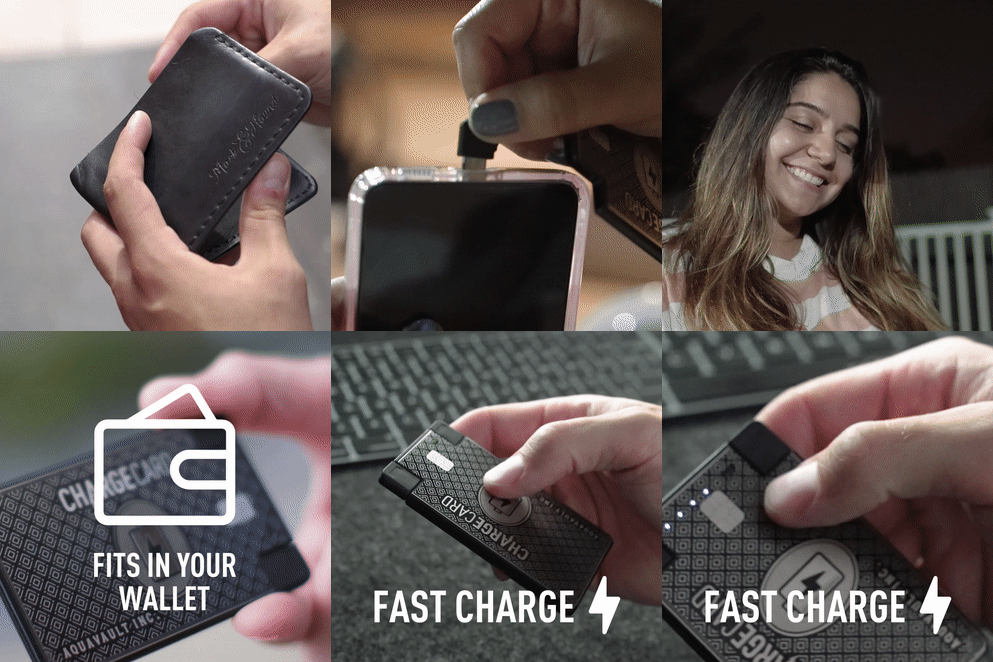
At its core, the Charge Card is designed to solve a specific problem: the bulkiness of traditional power banks. Most portable chargers are great until you have to carry them. They bulge in your pockets or take up valuable real estate in your purse.
The Charge Card flips the script by prioritizing an ultra-slim form factor. It is a portable charger roughly the size of a standard credit card (though a bit thicker, naturally), encased in stainless steel. It’s designed to slide into your wallet, pocket, or purse so seamlessly that you forget it’s there until you need it.
But it’s not just a battery. It comes with built-in charging cables for Apple (Lightning), Android (USB-C), and Micro USB devices. This means you don’t need to carry extra cords with you—a massive win for minimalists. It’s marketed as an "emergency" power source that’s always with you, backed by Daymond John from Shark Tank, which adds a layer of intrigue to its credibility.
First Impressions: Unboxing and Design
When the package arrived, I was immediately struck by how small the box was. We are so used to electronics coming in oversized packaging, but this was refreshing. Pulling the Charge Card out, the first thing you notice is the build quality.
It doesn’t feel cheap. The stainless steel casing gives it a premium, durable weight—not heavy, but solid. It feels like it could survive being sat on if it were in your back pocket (though I wouldn't recommend testing that intentionally!).
Aesthetically, it’s sleek. It looks more like a high-end business card holder than a piece of tech. The cables are neatly tucked away into the body of the card, maintaining that smooth profile. It’s definitely a device you wouldn't be embarrassed to pull out in a business meeting or a nice restaurant.
Key Features and Benefits
After spending some time with the device, a few features stood out as the primary reasons you'd choose this over a standard brick charger.
The "Credit Card" Design
This is the headline feature. The Charge Card measures just 3.3 x 2.3 x 0.1 inches and weighs only 2.2 ounces. To put that in perspective, it’s slightly thicker than a credit card but shares the same length and width. I tested sliding it into the card slot of my standard bifold wallet. It was a tight squeeze in the card slots themselves, but it fit perfectly in the billfold section or the hidden pockets behind the card slots. If you have a minimalist ridge wallet, it might be too thick, but for standard wallets and purses, it disappears.
Built-in Cables for Everything
I cannot overstate how convenient this is. I have lost count of the times I’ve had a power bank but no cable, or a cable but no wall plug. The Charge Card eliminates the "cable anxiety." It includes:
- USB-C: For modern Androids and newer Apple devices.
- Lightning: For older iPhones.
- Micro USB: For older Androids, Kindles, or headphones.
You don't need to check what device your friend has before offering them a charge; you’re covered.
LED Indicators
There are four simple LED lights on the device. These aren't just for show; they indicate how much power is left in the Charge Card itself. It’s a small detail, but knowing whether you have 25%, 50%, or 100% power left before you head out is crucial.
See Current Deals on Charge Card
Performance and Usage
Okay, it looks cool, but does it work? I tested the Charge Card on my smartphone (which has a 4500mAh battery) to see how it performed in the real world.
Charging Speed
The Charge Card utilizes 1.5A fast charging technology. In my testing, it wasn't as fast as my 20W wall charger (which is expected), but it was significantly faster than the old trickle-charge power banks I used to buy at gas stations. It provided a steady, reliable charge that got my phone from dead to usable in a matter of minutes. It fully charges a standard phone in roughly an hour, depending on the model and usage while charging.
Battery Capacity
The unit packs a 2300mAh battery. This is where you have to manage expectations. This is not a 20,000mAh brick that will charge your phone five times over a camping weekend. It is designed as a top-up or emergency charger.
For most modern smartphones, 2300mAh will provide a significant boost—likely between 50% to 80% charge depending on your phone's battery size. For me, it was enough to get me through the rest of the day and well into the night. It’s the difference between a dead phone at 5 PM and having power until you get home.
Ease of Use
Using it is foolproof. You pull out the cable you need, plug it in, and the LEDs light up to show it’s working. It also supports pass-through charging, meaning I could plug the Charge Card into a wall outlet to recharge it, while simultaneously having my phone plugged into the Charge Card. This is a great feature for travel when you might have limited outlets in a hotel room.
Pros and Cons
To give you a balanced view, here is a breakdown of what I loved and what you should consider.
Pros:
- Ultra-Portable: Truly fits in a wallet or pocket without bulk.
- Integrated Cables: No need to carry extra messy wires.
- Universal Compatibility: Works with Apple, Android, and other USB devices.
- Premium Build: Stainless steel feels durable and high-end.
- Pass-Through Charging: Charge the battery and your phone at the same time.
Cons:
- Capacity Limit: 2300mAh is great for a boost, but won't fully charge larger flagship phones from 0 to 100%.
- Price: It is more expensive than cheap, bulky plastic chargers (though you are paying for the engineering and size).
- Cable Length: The built-in cables are short, meaning your phone and the card need to be held together or sit next to each other while charging.
Who is Charge Card For?
This device isn't for everyone, but for a specific group of people, it’s a game-changer.
It is perfect for:
- Commuters: People who need that extra 30-40% battery to listen to podcasts or answer emails on the train home.
- Nightlife Enthusiasts: If you carry a small clutch or just a wallet, this ensures you have a safety net for calling a ride home.
- Business Professionals: It looks sleek in a meeting and saves you from crawling under a conference table looking for an outlet.
- Travelers: Excellent for long days of sightseeing where you don't want to carry a backpack.
It might not be for:
- The Heavy Camper: If you are off-grid for three days, you need a massive brick battery, not a slim wallet charger.
- The Power User: If you play high-drain mobile games for 8 hours straight, you'll need more capacity.
Is Charge Card Right For You? Check Here
How It Compares
I’ve used plenty of "slim" chargers before. Usually, they are made of cheap plastic that cracks after a month, or they require a separate dongle that I immediately lose.
Compared to generic slim chargers on Amazon, the Charge Card’s stainless steel build puts it in a different league regarding durability. While some competitors might offer slightly more mAh for the price, they almost always sacrifice the form factor—ending up twice as thick. The Charge Card finds the sweet spot between "actually slim enough for a wallet" and "powerful enough to be useful."
Real-World Scenarios
Here is where I found the Charge Card to shine the brightest during my week of testing:
The "After Work" Drinks
I left the office with 20% battery. Usually, I'd have to nurse my phone, turning off data and dimming the screen. With the Charge Card in my pocket, I plugged it in while walking to the bar. By the time I arrived, I was back in the green, ready to coordinate with friends.
The Airport Layover
Airport outlets are a battleground. They are either broken or occupied. Having the Charge Card meant I could sit comfortably at the gate without fighting for a wall plug, keeping my phone alive to display my boarding pass.
The Hiking Trail
I like to take photos when I hike, which drains the battery. I didn't want a heavy backpack. The Charge Card slid into my shorts pocket, unnoticed, and gave me enough juice to keep my GPS maps running for the return trip.
Potential Limitations
Transparency is key. As I mentioned, the cable length is short. You can’t plug this in and then use your phone comfortably two feet away. The phone and the card become a "sandwich." It’s not a dealbreaker, but it makes using the phone while charging slightly more awkward than with a 6-foot cable.
Also, remember that physics has limits. To get a battery this thin, you have to limit capacity. Do not buy this expecting it to charge an iPad Pro from dead to full. It’s a smartphone companion, not a laptop generator.
Final Verdict
After carrying the Charge Card for a week, I’ve stopped carrying my bulky brick charger entirely for daily use.
The Charge Card succeeds because it eliminates friction. It removes the friction of carrying a heavy battery. It removes the friction of untangling cables. It removes the friction of worrying about a dead battery.
Is it the most powerful charger on earth? No. But it is likely the most convenient one. It is the best charger because it is the one you will actually have with you when you need it. For peace of mind that fits in your wallet, it’s a solid investment.
Where to Buy
To ensure you get the genuine product with the stainless steel build and the warranty, I highly recommend purchasing directly through their official channel. There are many cheap knock-offs out there that look similar but use inferior, unsafe batteries.
Reader Q&A
Q: Can I take this on an airplane?
A: Yes! The Charge Card is safe for air travel and is allowed in your carry-on luggage.
Q: Does it work with a phone case?
A: Yes, the built-in cables generally fit through standard case openings. Unless you have an exceptionally bulky waterproof case with deep ports, it should work fine.
Q: How do I recharge the Charge Card itself?
A: It recharges via a standard USB cable (included). It takes about 2-3 hours to juice it back up to full power.
Conclusion
In a digital age, power is currency. The Charge Card offers a wealth of convenience in a package small enough to forget about until the moment you desperately need it. It bridges the gap between style and utility, offering a lifeline for your devices without cramping your style. If you are tired of dead batteries and tangled cords, this slim gadget might just be the best accessory you buy this year.